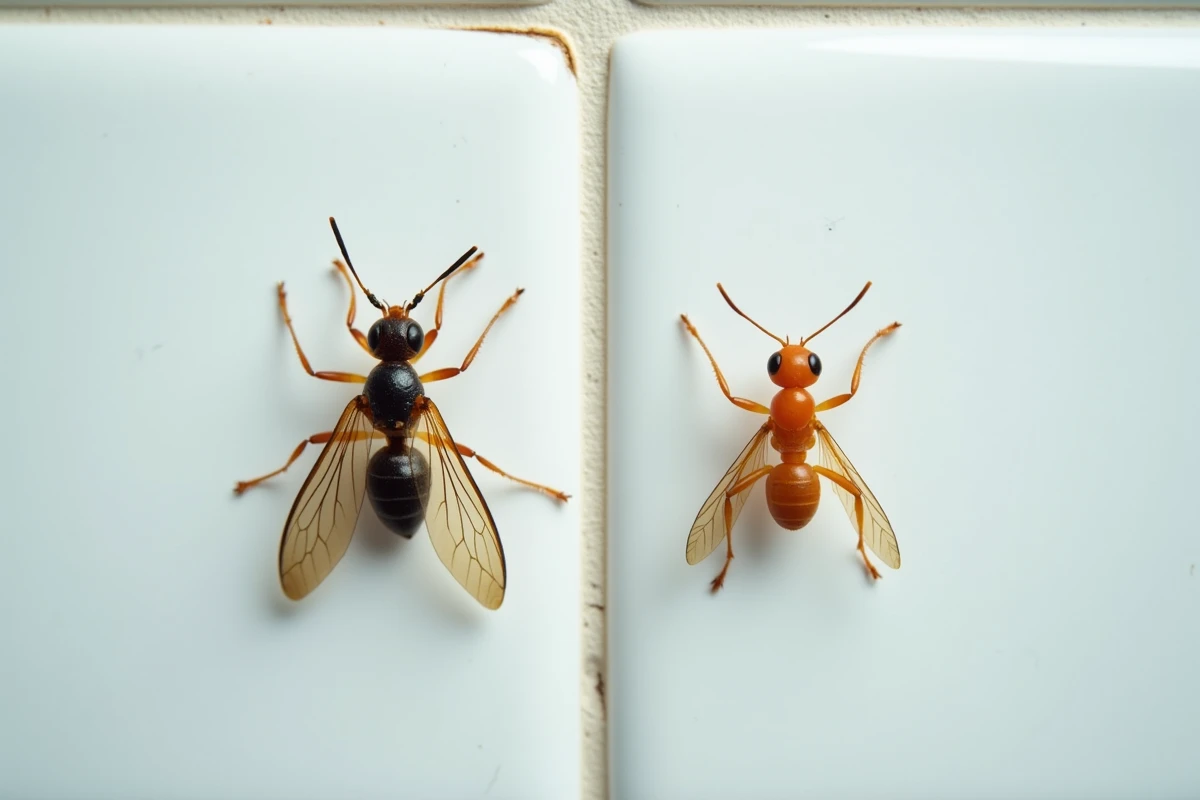
Flying ants and winged termites share a similar silhouette: a dark body, two pairs of wings, and a size of a few millimeters. The confusion between these two insects is based on this superficial resemblance, but three anatomical criteria allow them to be distinguished without special equipment.
Structural clues in an upper-floor or recently renovated apartment
Most guides assume that termites only concern old ground-floor houses, with exposed beams and damp basements. This hypothesis is too restrictive.
Documented cases from professionals show that termites can be detected on upper floors of buildings or in unexpected interior areas. A renovated apartment with new wood is not safe if the building has moisture rising in the walls, leaks in the plumbing, or insufficient ventilation in technical ducts.
Understanding the difference between flying ants and termites then makes perfect sense, even when living on the third floor of a recent residence. Humidity remains the distinguishing factor: if the apartment accumulates persistent condensation and degraded woodwork, the risk of termites exists regardless of the floor.
Flying ants, on the other hand, often appear near windows or light sources during their nuptial flight. Their presence does not indicate a structural problem, but simply a seasonal swarming from a nearby colony.

Comparative morphology: wings, antennae, and body size
Identification relies on three areas of the body, observable to the naked eye or with a simple pocket magnifier.
The wings, the first reliable criterion
Winged termites have four wings of equal length, all significantly longer than the body. After swarming, these wings fall off easily: translucent wing piles are often found on the ground, near baseboards or on window sills.
Flying ants also have four wings, but the two front wings are visibly larger than the hind wings. They do not detach spontaneously.
The antennae, a quick clue
The antennae of the termite are straight, made up of small aligned beads (moniliform antennae). Those of the ant are bent, with a marked angle at the first third.
Bent antennae indicate an ant, straight antennae indicate a termite.
The overall silhouette
The body of the termite forms an almost uniform cylinder, with no visible narrowing between the thorax and abdomen. The ant has a very marked waist, a fine constriction that clearly separates the two parts of the body.
- Termite: cylindrical body, no marked waist, often light color (cream white to pale brown for workers, darker for winged ones)
- Flying ant: wasp-like waist clearly visible, segmented body, color varies by species (black, brown, reddish)
- Wings fallen on the ground without a visible insect: suspect a termite swarm and check nearby woodwork
Signs and damage: what the insect leaves behind
Observing the living insect is not always possible. Indirect clues are sometimes more telling than direct observation.
Termites consume wood from the inside. A baseboard, door frame, or attacked floorboard retains its exterior appearance intact but sounds hollow to the touch. Pressing with a tool, the wood collapses and reveals parallel internal galleries, often lined with a earthy coating.
Carpenter ants, sometimes confused with termites due to their size, also burrow into wood, but to nest, not to feed. Their galleries are clean, smooth, and accompanied by small piles of fine sawdust ejected outside the wood. Fine sawdust at the foot of a woodwork points to a carpenter ant, not a termite.
The absence of visible sawdust with wood that appears weakened from the inside is a serious warning signal. In this case, checking by a wood diagnostic professional becomes relevant, especially if the apartment is located in a municipality classified as a termite risk zone.
Swarming periods and context of appearance in the apartment
The time when winged insects appear provides an additional clue.
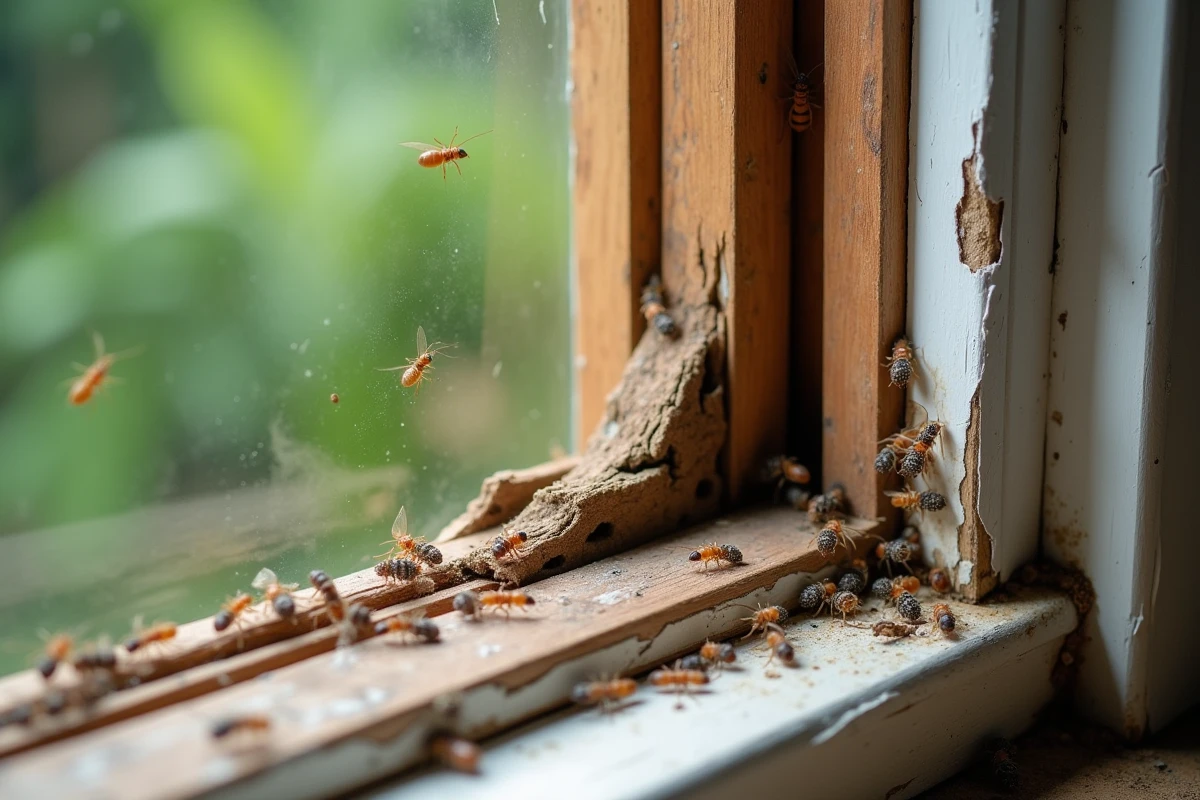
Flying ants typically swarm on warm, humid days, often between late spring and early summer. The swarming is massive, brief, and occurs during the day. The insects are attracted to light and are frequently found stuck to windows or clustered around lamps.
Winged termites also swarm in spring, but their flight often occurs in the late afternoon or evening, sometimes after rain. The quantities can be significant, with dozens of wings found the next morning.
- Daytime swarm, near windows, after a hot day: likely nuptial flight of ants
- Wings found on the ground in the morning, without visible insects, near woodwork: suspect a termite swarm
- Recurring winged insects over several days in the same spot: the colony is likely established in the building or in close proximity
A one-time swarm of flying ants usually does not require any structural treatment. A swarm of termites, even limited in number, justifies an inspection of the woodwork and the load-bearing structure of the building.
The location of fallen wings remains the last clue not to be overlooked. Concentrated wings near a crack in a wall, a window joint, or a plumbing passage indicate an entry point. Finding these wings indoors, far from any opening, suggests that the colony is already inside the building.